


Bringing Regulatory Leaders Together to Explore AI
Regulators and inspectorates are operating in an increasingly complex and fast-moving environment. The pace of change in the sectors they oversee is accelerating, expectations for more risk-based and responsive approaches are growing, and many are managing rising volumes of applications, industry interaction and information with constrained resources. These pressures are prompting a re-examination of how regulatory services are designed and delivered. Against this backdrop, new and emerging AI technologies offer significant potential.
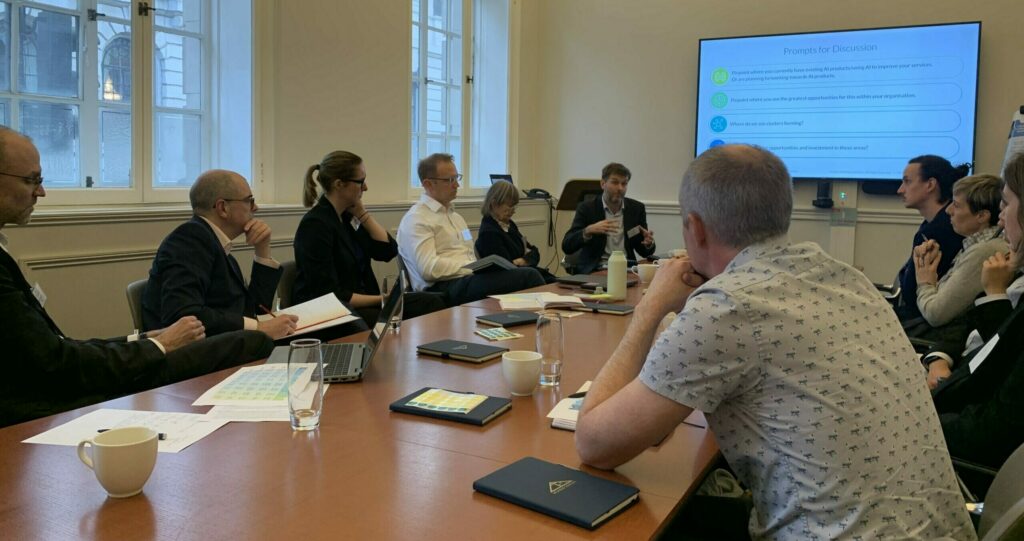
To explore those opportunities in more detail, we brought together a group of senior leaders from regulatory organisations for a roundtable in central London on Wednesday 11 March. Faciliated by Informed Solutions’ heads of practice Sara Di Domenico (User Centred Design) and Sebastian Uhlig (Live Service Operations), and chaired by Informed Solutions’ Chief Innovation Officer, David Lawton, the three-hour session focused on three key themes: the opportunities offered by AI across the regulatory lifecycle, learning from examples of live AI deployment in regulators and inspectorates, and key enablers for moving from AI exploration to leveraging AI in live services.
The aim was to build a shared understanding of the current state of AI usage across regulators, where they are seeing value, what approaches are delivering success, and how organisations can put their best foot forward to realise benefits quickly, responsibly and with confidence.
“There is real enthusiasm to explore AI, but organisations want to do it in the right way.”
Key Reflections From the Roundtable
The discussion surfaced a number of consistent themes across regulators:
- There is strong recognition of the potential of AI, and a clear desire to adopt it in a practical, responsible way that aligns with regulatory purpose
- The greatest near-term value lies in targeted use cases that save expert time and improve consistency and user experience
- Progress depends on leadership, skills, and the ability to build clear, outcome-focused business cases
- AI adoption must be part of wider regulatory transformation, particularly where organisations are not yet structured around services
- Existing government standards and guidance provide a useful foundation, but questions remain around how legislation could supports more risk-based approaches
- For some organisations, AI adoption is already a strategic, board-level consideration
A Sector With Real Momentum
One of the clearest messages from the discussion was that there is genuine enthusiasm for AI across the regulatory community. While many organisations are still in the early stages of adoption, there is strong awareness of the potential and a clear appetite to explore where it can make the biggest difference.
For many, current use is centred on productivity tools such as Copilot, alongside a growing number of proofs of concept and pilot projects. This reflects the measured way regulators are approaching AI adoption as they test use cases, build confidence and identify where the greatest benefits can be realised.
Where AI Is Already Showing Promise
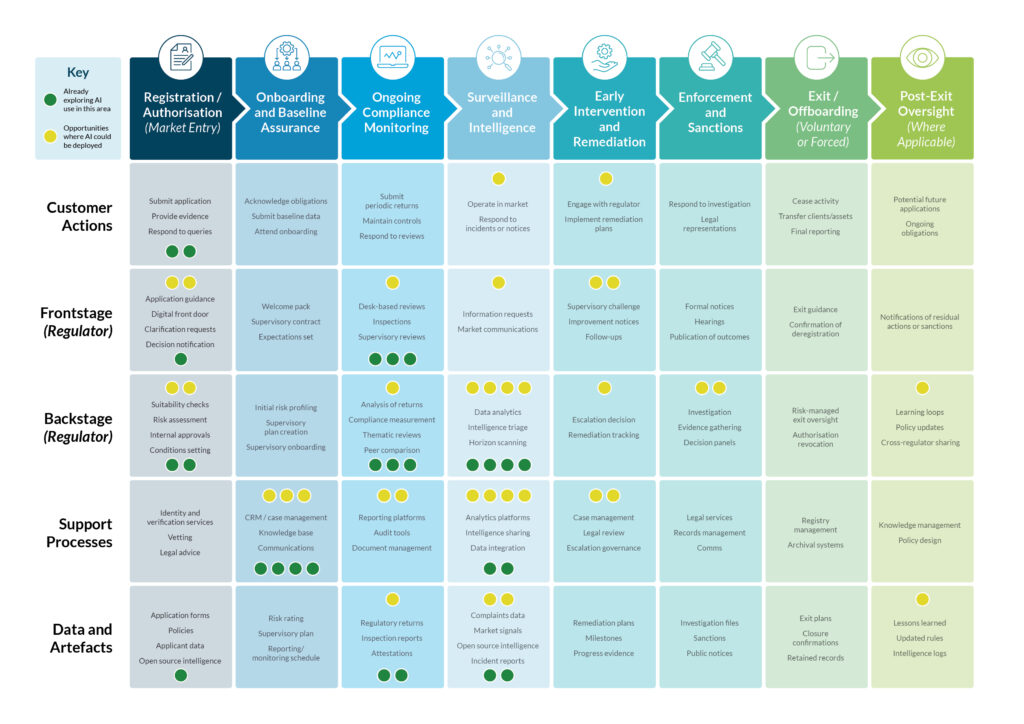
The roundtable highlighted several areas where AI is already showing clear promise. Information-heavy parts of the regulatory lifecycle appear particularly well suited to early adoption. These include potentially transformative speed and efficacy improvements in handling applications, reviewing submissions, analysing previous cases, responding to queries and managing large volumes of material. We presented practical examples from Informed’s experience working with NatureScot, HMICFRS and MHRA on some of these use cases
Participants also shared examples of AI pilots and live systems that are helping teams unlock the value held in historic case information and generating more consistent responses based on precedent and policy. Others noted that functions dealing with large volumes of text or repetitive information requests may be especially well placed to benefit from AI. There was also discussion about regulators’ “digital front door” and how AI could improve the way services are presented, how information is captured and how guidance is provided to users to prevent poor-quality or incomplete information reaching internal teams.
The Regulatory Lifecyle
Responding to a Changing Regulatory Landscape
A major theme of the roundtable was that regulators and inspectorates are not exploring AI in isolation. The organisations, professionals and citizens they regulate are already using AI too. That is changing the nature of applications, queries and submissions, which are rapidly becoming longer, more detailed and more sophisticated.
Several participants noted the practical impact this is already having. As one comment captured, “applications are getting longer and more detailed as they are created using LLMs.” The Chair reflected that we might be in the foothills of an “AI arms race” between the regulated and regulators. Yet, there was a strong sense that this changing landscape creates an opportunity for regulators to adapt and improve their own processes, guidance and services in response.
This included the potential for much clearer guidance, better structured services and more intelligent interventions within application and submission processes. In that sense, AI is not simply a back-office efficiency tool: it also creates an opportunity to redesign services around user needs and regulatory outcomes, with the potential to accelerate towards a more risk-based approach to regulation.
Doing It Right: Leadership, Culture and Confidence
A particularly positive aspect of the discussion was how seriously regulators are taking the question of responsible adoption. There was broad recognition that AI should not be pursued for its own sake. Success depends on backing the right use cases to deliver the most value, whilst building trust and confidence across both leadership and frontline teams.
Senior sponsorship was widely seen as important in helping AI initiatives move beyond isolated experimentation. At the same time, participants also noted that momentum can build from the ground up when pilot projects demonstrate clear value and learnings are shared across an organisation. ‘Winning hearts and minds’ remains an important part of the journey, particularly where teams are navigating organisational change, funding pressures or legacy ways of working.
“You have to win hearts and minds to get the investment.”
The discussion suggested that regulators are approaching AI with a balance of optimism and care: open to transformation but determined to ensure it is introduced in a way that is practical, risk-proportionate and aligned to their public purpose.
Protecting Knowledge and Building Capability
One of the strongest opportunity areas discussed was the role AI can play in preserving organisational knowledge and supporting workforce capability. Regulators are highly aware of the risks created by staff turnover, particularly where expertise sits across expert staff and in historic decisions, submissions, precedent and policy that can be difficult to access quickly.
AI offers the potential to unlock that knowledge securely and intelligently, helping organisations reduce inconsistency, support new starters and make better use of what they already know. Participants saw clear value in tools that can surface relevant precedent and insight from large volumes of unstructured in-house material.
The discussion highlighted interest in opportunities where technology could make better use of existing regulatory knowledge and data. Informed Solutions referenced the way NatureScot is using the InformedDECISION™ Knowledge Hub platform to securely draw on previous applications, submissions, policy, and precedent to save expert time, improve consistency, support onboarding, and reduce the risk of knowledge loss.
“If you can unlock the value of everything the organisation already knows, that is a powerful starting point.”
Shared Challenges, Shared Opportunities
Although the regulators represented around the table came from different sectors, there was striking commonality in the issues they raised. Questions around funding, organisational design, data accessibility, service models and legislative pace were familiar to many in the room.
But so too were the opportunities. Across sectors, there was a sense that regulators are grappling with similar challenges and may benefit from shared approaches, common patterns and practical examples of what works. The conversation was not one of hesitation, but of ambition to move quickly.
It was clear that all attendees were considering the transformational potential of AI on their businesses – is it simply a new capability that should be adopted, tested and integrated into the business, or is it a more transformational disruptor that has the potential to enable regulatory services to be reimagined in the future? As one contribution put it, “conceptually people can treat it as a tool but, at the same time, it is also radically transformational.” That captured the mood well: regulators see the practical value AI can deliver now, while also recognising its longer-term significance.
A Positive Path Forward
The roundtable made clear that the opportunity for AI in regulation and inspection is significant. Regulators are already identifying valuable use cases, building internal understanding and leadership, and exploring how these technologies can support better, more effective and pro-active regulation.
The discussion also highlighted that progress will depend not just on technology, but on the wider regulatory context in which it is applied. Participants reflected on the role of existing standards and guidance, with frameworks such as GOV.UK standards, the AI Playbook, and the AI assurance framework seen as important enablers for responsible adoption. At the same time, questions were raised about whether current legislation is keeping pace with calls for more risk-based approaches to inspection, with attendees noting both constraints and areas of flexibility in current legislation.
There was also a strong recognition that AI cannot be treated as a standalone capability. Real impact will require it to be embedded within broader regulatory transformation, particularly where organisations are not yet structured around service-based models. This links closely to the need to build compelling AI business cases, with attendees emphasising the importance of senior leadership sponsorship, prioritising the right use cases, and focussing on tangible benefits such as freeing up expert time for high value decision making and improving user and customer experience.
The mood in the room was constructive and forward-looking. There is enthusiasm, there is momentum, and there is also a clear sense that adopting AI brings strategic considerations. Some regulators are already beginning to recognise AI adoption as a board-level risk, requiring active planning and oversight.
“The biggest risk is that we don’t take the opportunity.”
That is an encouraging place to start. The opportunity is there, and practical exemplars of AI deployment at scale are already demonstrating the potential that can be realised. Regulators are approaching this with the care, responsibility, and ambition needed to deliver real impact.
Key Takeaways
- AI adoption must be grounded in practical use cases that deliver real value, particularly through improving outcomes and making better use of expert time.
- Progress will depend on strong leadership, and the ability to build compelling, outcome-focused business cases.
- Strong exemplars for the practical deployment of AI in regulators exist, and demonstrate the benefits that can be achieved at scale.
- AI should be seen as part of wider regulatory transformation, not as a standalone initiative.
- There is a need to make best use of existing standards and guidance, while continuing to navigate legislative constraints and opportunities.
These takeaways underline both the progress being made and the practical challenges ahead, while reinforcing a shared commitment to moving forward with purpose and pace.

Talk to Us
Get in touch for more information on how we can help you accelerate and de-risk your digital business change.